

Today, LimeCulture is pleased to launch two significant new resources, funded by the Ministry of Justice, to support the continued development, consistency and sustainability of Independent Sexual Violence Adviser (ISVA) services across England and Wales.
The new resources are:
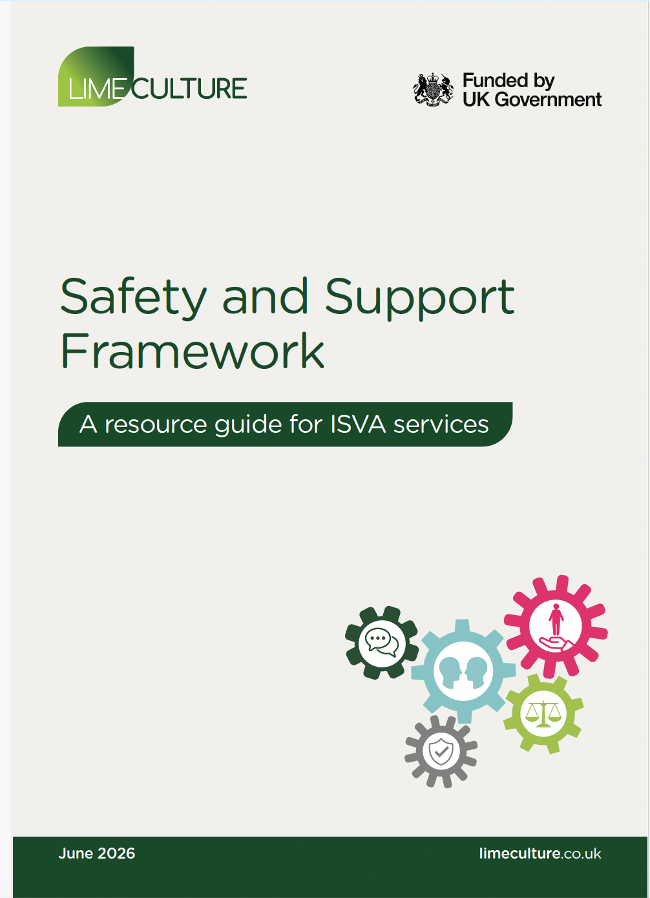
- The revised Safety and Support (SaS) Framework, including the newly developed SaS Framework for Children and Young People
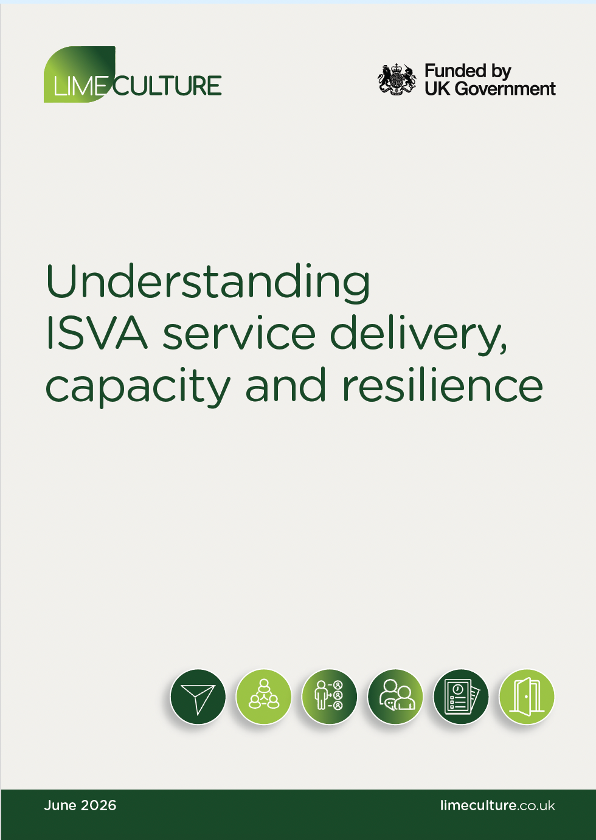
- Understanding ISVA Service Delivery, Capacity and Resilience, a national study examining how ISVA services operate in practice and the factors affecting service delivery, workforce resilience and sustainability
Together, these resources provide a complementary framework for strengthening both frontline ISVA practice and wider service delivery.
The revised SaS Framework supports structured assessment, support planning and defensible decision-making with individual victims and survivors. The Service Delivery, Capacity and Resilience report explores how ISVA services can be designed, managed and commissioned to respond effectively to increasing demand and complexity.
Why these resources matter
ISVAs play a critical role in supporting victims and survivors of sexual violence to navigate recovery, access services and engage with criminal justice processes where they choose to do so.
However, ISVA services are operating in an increasingly challenging environment. Rising demand, growing case complexity, workforce pressures and prolonged criminal justice timelines continue to place significant strain on services across England and Wales.
The national study highlights that effective ISVA service delivery depends not only on the work of individual practitioners, but also on the strength of the wider operational systems that support referral, triage, allocation, active support and closure.
It shows that ISVA services should be understood as integrated operational systems, where access and demand management, service coordination, oversight and workforce resilience are all critical to delivering safe, effective and survivor-centred support.
Alongside this, the revised SaS Framework provides an updated practice framework to support ISVAs to identify, assess and respond to risk, unmet need and protective factors throughout the entire support pathway. The inclusion of a dedicated Children and Young People framework further strengthens the sector’s ability to deliver developmentally appropriate, child-centred support.
The revised Safety and Support Framework
The Safety and Support Assessment was originally developed by LimeCulture in 2016–17 with Home Office funding. It was the first nationally available structured risk and needs assessment framework specifically designed for ISVAs supporting victims and survivors of sexual violence.
It was developed in response to significant variation in assessment practice across the sector and aimed to support more consistent identification of risk, unmet need and support requirements. The original framework established a domain-based approach to assessment and promoted ongoing review, collaborative working with clients and structured support planning.
The revised SaS Framework represents the most significant update since its original publication.
Informed by almost a decade of implementation across ISVA services, developments in trauma-informed practice, changes in statutory guidance and extensive engagement with the sector, the framework has evolved from an assessment tool into a broader practice framework that supports ISVAs throughout the entire support journey.
A major development is the introduction of the SaS Framework for Children and Young People. For the first time, ISVA services have access to a dedicated framework designed specifically for children and young people (CYP). The CYP framework reflects child-centred and developmentally informed practice, recognising that children and young people may communicate risk, safety and support needs differently from adults.
While tailored to younger people, the CYP framework remains fully aligned to the overarching SaS methodology, helping to promote consistency across adult and CYP provision.
Collectively, these developments position the revised SaS Framework as a comprehensive practice resource that supports high-quality, consistent and evidence-informed ISVA practice across assessment, planning, review and closure.
Understanding ISVA Service Delivery, Capacity and Resilience
The Understanding ISVA Service Delivery, Capacity and Resilience report examines how ISVA services operate in practice across England and Wales and identifies the factors that influence sustainability, quality and access to support.
The study combined service-level discussions, operational data and analysis of alignment with statutory guidance to develop a detailed picture of contemporary ISVA service delivery.
It identifies four interdependent components that underpin effective service delivery:
- The ISVA service support pathway
- Access and demand management systems
- Coordination and oversight infrastructure
- Workforce resilience structures
The findings reinforce the importance of understanding ISVA services not only through individual caseloads, but through the wider systems, structures and resources required to deliver safe, responsive and sustainable support.
Supporting implementation and improvement
Today’s launch marks the start of a wider programme of dissemination and implementation activity designed to support ISVA services, commissioners and partners to embed the revised SaS Framework and apply the learning from the national study.
Together, these resources provide a stronger evidence base for assessment, support planning, service design and commissioning.
They are intended to support a more consistent, sustainable and victim/survivor-centred future for ISVA provision across England and Wales.
Acknowledgements
LimeCulture would like to thank the ISVA services and organisations who generously supported the development of these resources by sharing their time, expertise, operational learning and practice insight.
We are particularly grateful to:
- We Are Survivors
- SafeLink
- Rape and Sexual Abuse Counselling Centre, Darlington & County Durham
- New Pathways
- Imara
- Victim Support – The Castle Service
- Nottinghamshire Sexual Violence Support Services / Notts SVSS
Their contributions have helped ensure these resources are grounded in the realities of contemporary ISVA service delivery and reflect the complexity, expertise and commitment of the sector.
To review the resources and register for our online learning click here:
Discover more from LimeCulture
Subscribe to get the latest posts sent to your email.